Employer Benefits IQ
Employer Benefits Decision Intelligence

Stop overpaying for health benefits. Start making smarter decisions.

Start with your Benefits IQ Score™ to identify priorities, then use independent tools, vendor intelligence, learning, and practical guidance to act.

Free to start. No vendor-sponsored rankings.

Your benefits operating system

A clear path from plan data to better decisions.

01Measure
02Analyze
03Compare
04Prioritize
05Improve

48 Tools

185 unique vendors · 232 published profiles

114 modules · 217 individual lessons

66+ Insights

Start with your priority

Five ways employers move from questions to action

Pick the business problem in front of you. Each path starts with one focused action, then guides you to the next tool or benchmark only when it is useful.

Start here

Reduce My Renewal

Pressure-test renewal assumptions and identify the levers worth evaluating first.

Renewal reduction

A 1,200-employee manufacturer used renewal modeling and market benchmarks to redirect a projected double-digit increase into a targeted plan and vendor review.

Created a prioritized renewal strategy before carrier negotiations.

See composite case studies
Review renewal
Start here

Fix My Pharmacy Spend

Find the contract, rebate, specialty, and pricing questions behind pharmacy costs.

Pharmacy spend

A self-funded employer used PBM contract findings to focus on rebate pass-through, specialty pharmacy, and audit rights before its next contract cycle.

Built a pharmacy negotiation checklist around the highest-risk terms.

See composite case studies
Review PBM contract
Start here

Evaluate Self-Funding

Assess readiness, risk protection, and the data you need before changing funding.

Self-funding readiness

A growing employer used a readiness assessment to clarify financial controls, stop-loss protections, and administrative requirements before changing funding.

Moved from a broad idea to a sequenced implementation decision.

See composite case studies
Check readiness
Start here

Evaluate My Vendors

Compare benefit partners using a consistent, employer-first evaluation lens.

Vendor evaluation

An employer team compared navigation and cost-containment options against a defined workforce need instead of evaluating vendor promises in isolation.

Narrowed the evaluation to the criteria that mattered most.

See composite case studies
Compare vendors
Start here

Benchmark My Benefits

See how plan costs and design choices compare with relevant market context.

Benefits benchmarking

An employer profile and benchmark review surfaced plan-design and contribution questions that were not visible in the renewal summary alone.

Identified practical questions to take into the next benefits review.

See composite case studies
Start benchmarking

Composite examples based on real-world employer plan outcome patterns. Results vary by plan, workforce, market, and implementation.

Corry Hull, REBC® CSFS®

Built by an employer benefits specialist

Corry Hull, REBC® · CSFS® · Health Rosetta Advisor

Corry Hull is an Employer Healthcare Strategist and author of The High Performance Health Plan. He helps employers use data, contracts, and better purchasing to build high-performance health plans.

Explore Corry Hull’s credentials
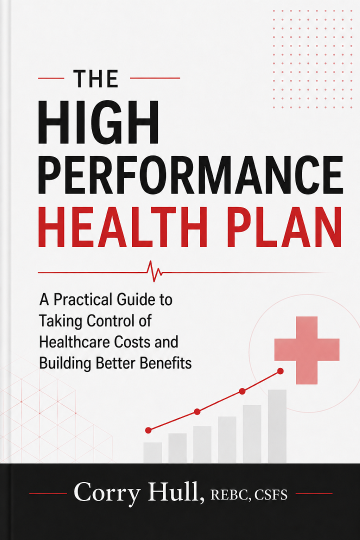
The High Performance Health Plan by Corry Hull

New from Corry Hull

The High Performance Health Plan

A practical guide to taking control of healthcare costs and building better benefits.

The High Performance Health Plan is the executive methodology, proprietary Framework, Health Plan Score™, Roadmap™, book, and definitive authority. Employer Benefits IQ provides the practical education, tools, data, and decision support to help employers apply it.

Learn more about the book
Composite illustration

How a 340-life manufacturer rebuilt its health-plan buying strategy

This composite illustration combines elements from multiple completed engagements. Identifying details are changed to protect confidentiality; financial outcomes are reported net of the plan costs defined below.

Midwest manufacturer · 340 benefit-eligible employees · approximately 290 medical-plan participants

Baseline

Three consecutive fully insured renewals of 18–22% left leadership without a claims-based view of cost drivers or a competitive stop-loss market check.

Interventions

Three years of claims were modeled; eight stop-loss carriers were quoted; a regional TPA and optimized network structure were selected; the plan launched with $75,000 specific and 120% aggregate protection.

Measurement period

January–December 2024, compared with the incumbent carrier's January 2024 fully insured renewal. Savings are renewal premium less actual claims, stop-loss, TPA fees, and administrative costs; broker compensation, internal HR time, and one-time transition costs are excluded.

Employee impact

The employer kept medical coverage in place while moving to a structure designed to improve cost visibility, maintain network access, and give employees a clearer path for questions during the transition.

Illustration context

This example combines themes and outcomes from multiple engagements; it is not a documented account of one employer. It is provided to illustrate a possible evaluation process, not to guarantee future performance.

Read the case study methodology
Free — No credit card

See how your plan stacks up.

Start with the five-minute Benefits IQ Checkup™. As you complete tools and reviews, your Benefits IQ Score™ becomes an ongoing operational view that informs your Benefits Strategy Action Plan.

Start independently. Bring in expert support when you are ready to implement.